


Another Wednesday without football, another day to talk some ball as the next closest thing.
Anyway, we’re at the point in the season, 3 weeks in, where there exists some sample of data to adjust our pre-season priors, but enough uncertainty as to its small sample that there is large disparity for how to price various teams and how to understand from the first few weeks what carries signal and what is more noisy.
Let’s talk about a surprising 3-0 team this year as illustration of thinking through these sorts of situations… DAAA RAIIIDDERS
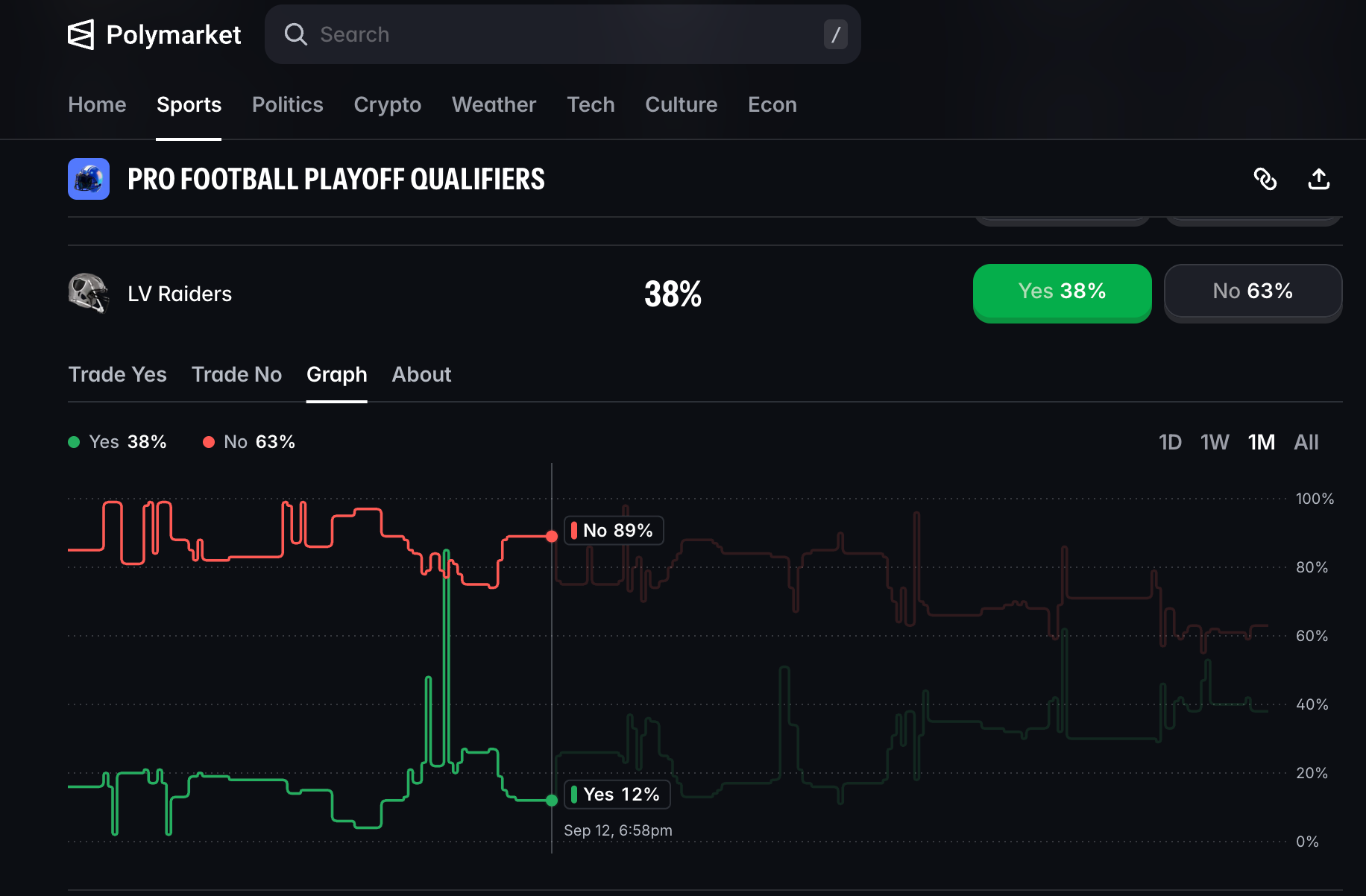
The Raiders began the 2025 season with a ~11.5% chance to make the playoffs, and its 5.5 win total is one of the lowest on the board for the season. And now this is a team with a 40% chance of the playoffs and a win total around 8.
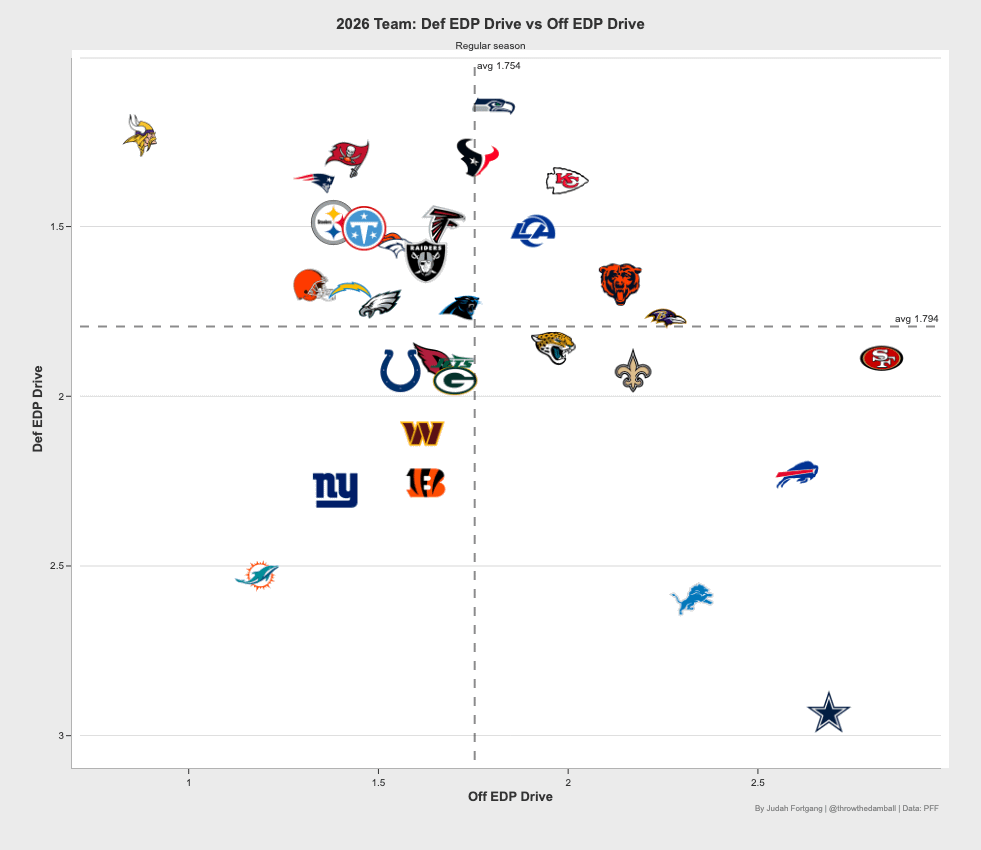
Here we have offensive and defensive Earned Drive Points, which looks at how well teams sustain drives, as defined by their efficacy and reproducibility (primer here). So while you can’t take away the 3-0 start from the standings, from an efficiency standpoint this has been only an average team.
But is their early success stable? What might we be able to learn from their first 3 games to be able to better evaluate the next 14? It is natural to start with what changed from last season—where they had the worst record—to this season’s 3-0 start, and the natural starting point is with new Head Coach and playcaller Klint Kubiak and Quarterback Kirk Cousins. Cousins has been an average to below average QB by nearly any statistical measure you’d want to use.
But what is perhaps most interesting is how his play has been elevated early in system plays, or plays in which the QB is going to his first read and where the QB is in rhythm undisturbed by good coverage, pass rush or a bad snap/WR falling down. While the QB still needs to make the right read and deliver an accurate ball, these plays in system, more than others, are ones less owned by the QB and more so on surroundings (scheme getting guys open and receivers getting open and winning after the catch).
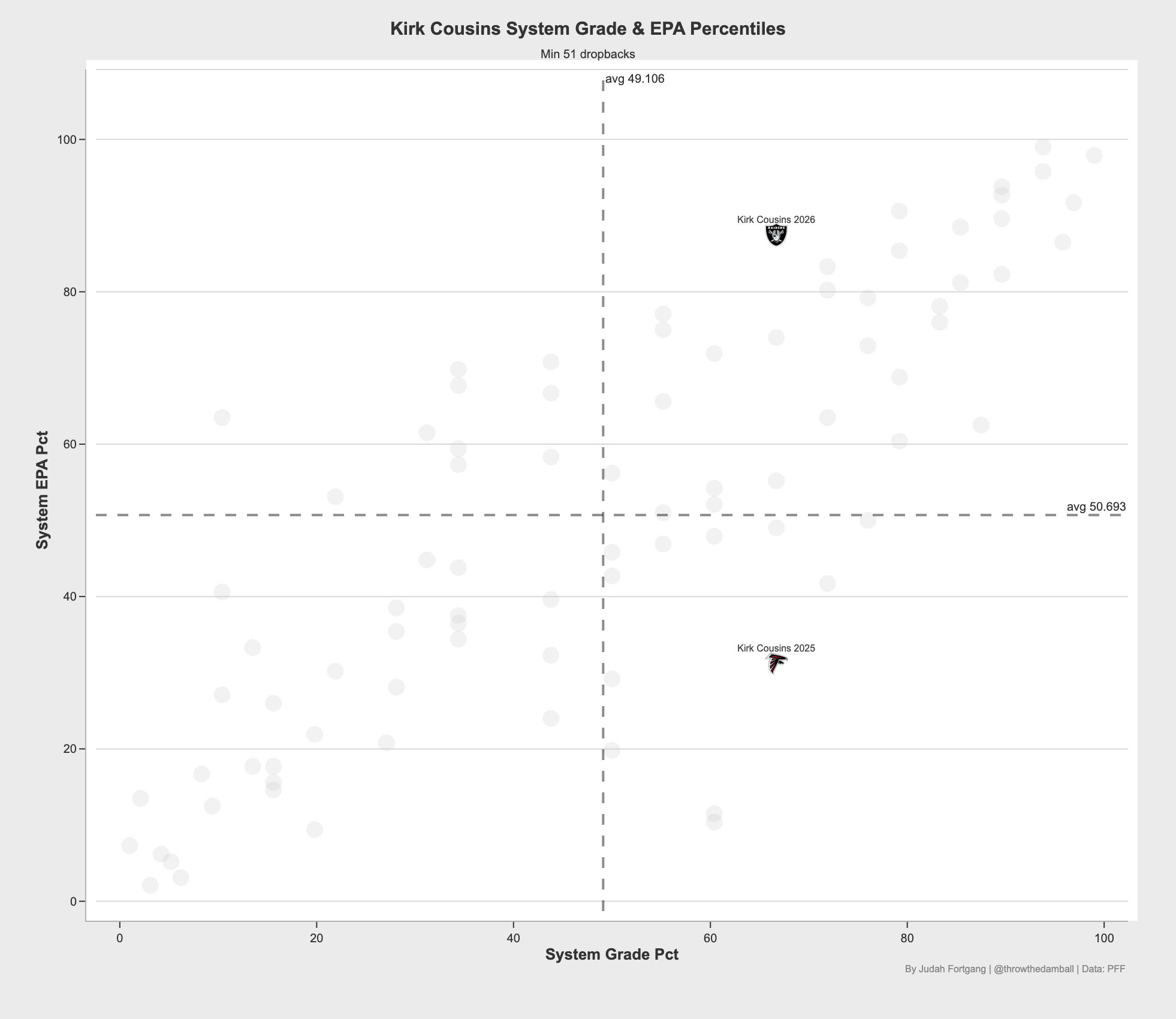
On the X axis we have the percentile grading of the QB on these system plays, capturing decision making and ball placement, where Cousins has been a solid 65th percentile QB in each of the last 2 years. And on the Y axis we have EPA, which captures the production of which a QB contributes, but it encapsulates more of the effects we just outlined of scheme and receiver playmaking within that.
Now what might this suggest? Cousins is the same QB he was (and has been, which is stability we crave within a football dataset so small), but his ability to make good decisions and throws has led to better production in Kubiak’s scheme than with Atlanta last season.
Now the run game has struggled for the offense, bottom 10 in EPA/Play and Rush Success Rate which has brought down the overall efficiency of the offense (chart above). But with matchup nightmare Brock Bowers back last week, this is a team that should see far fewer heavy boxes (plays in which the defense stacks the middle to try to stop the run) that will make life easier on the run game (they’ve seen the 4th highest loaded box count).
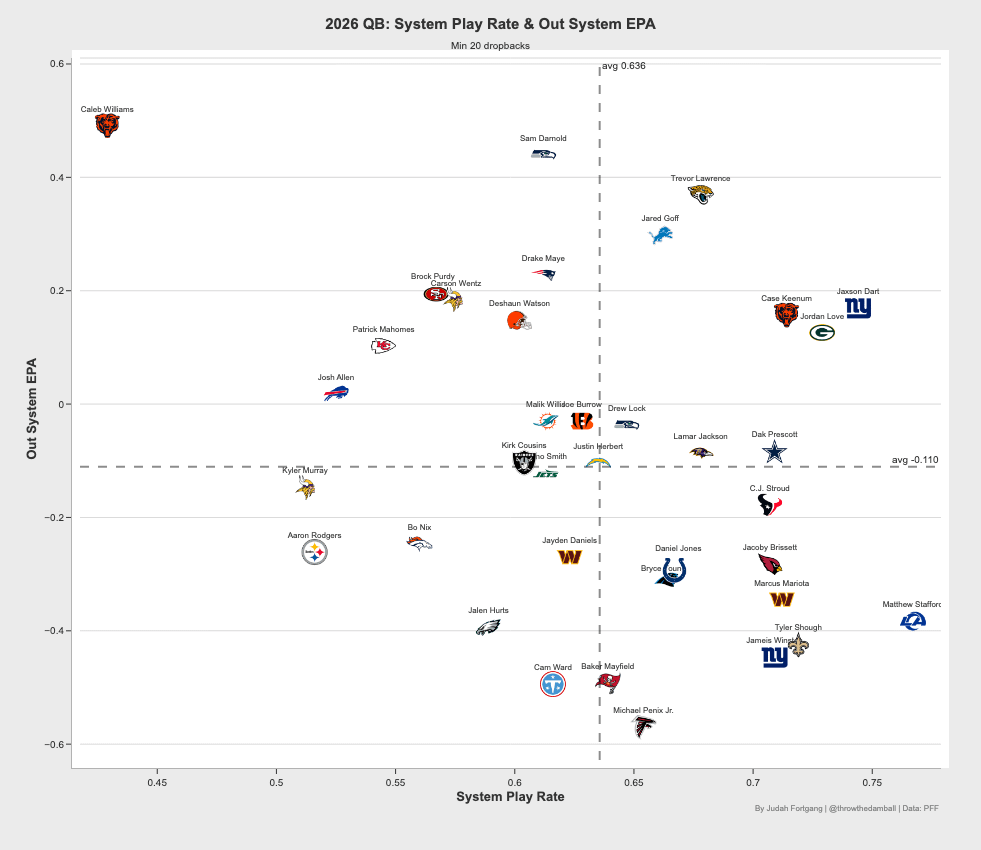
Of course, how well an offense plays in the system is only part of the offense (60% of plays for the Raiders) and Cousins has been average on those out of system plays, often as he works through progressions.
The offense might not be the top unit the NFL, but with the scheme elevating Cousins as he remains roughly the same player he’s been, there is good reason to think the Raiders offense is right about league average, despite the market—at least as tracked by market ratings via Inpredictable—having them still closer to below average.
On the defensive side of the ball, the dominant feature has been the ability to force turnovers, generally an area that is less stable in the NFL (whether the fumble was recovered or the tipped ball picked or into a defender’s hands is often random). This is to say: it is very unlikely for the team to sustain the number of points they’ve forced this season which has made them the 2nd best defense by EPA.
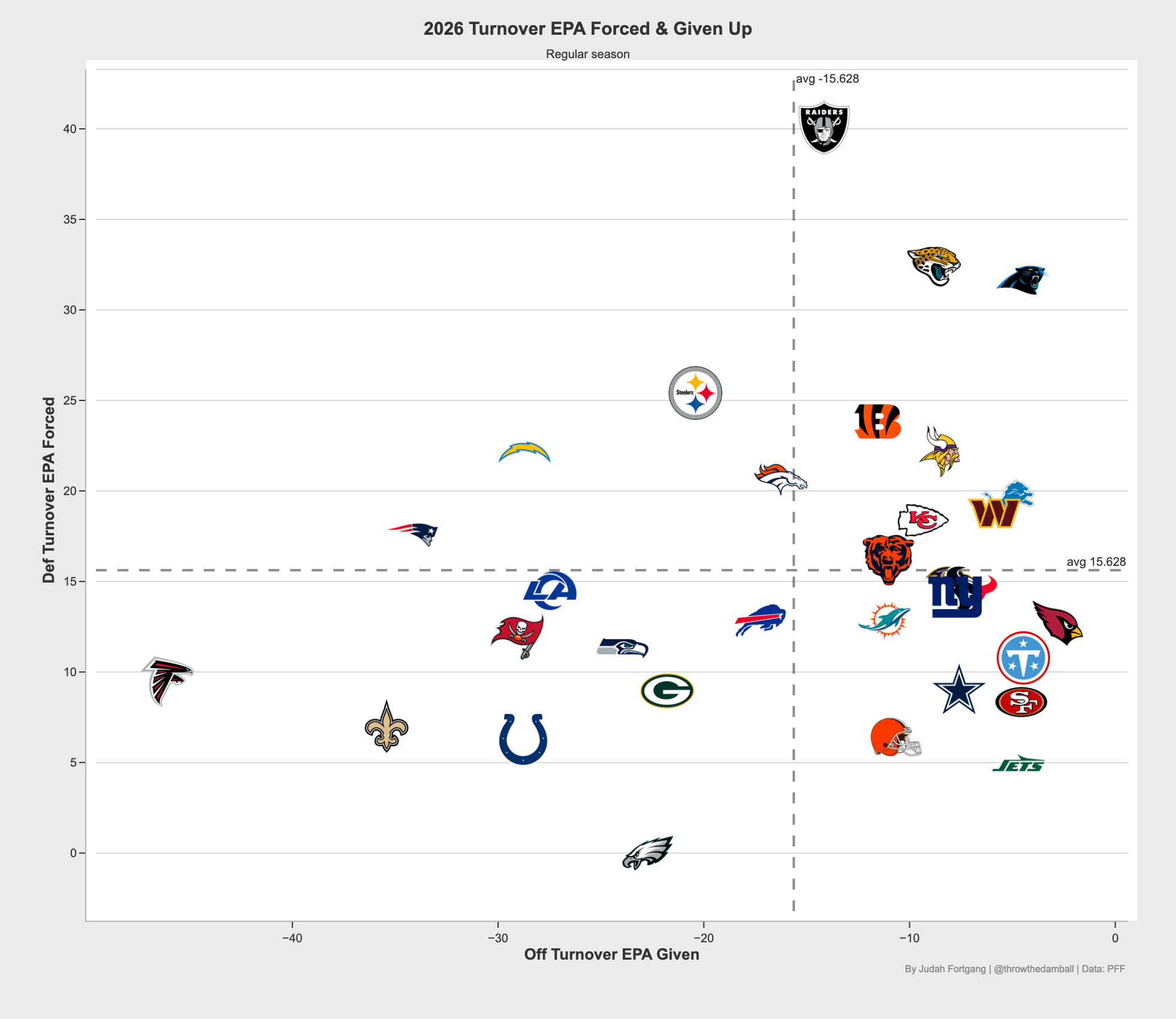
In terms of total points gained on turnover this is a Raiders team generating close to 40 points off turnovers 7 more than the next closest and 25 points about league average. Now that level is unlikely to sustain itself, but the Raiders have done a good job creating the conditions for turnovers, which is a more stable area of play and can still be reason to generate above average turnover rates moving forward.
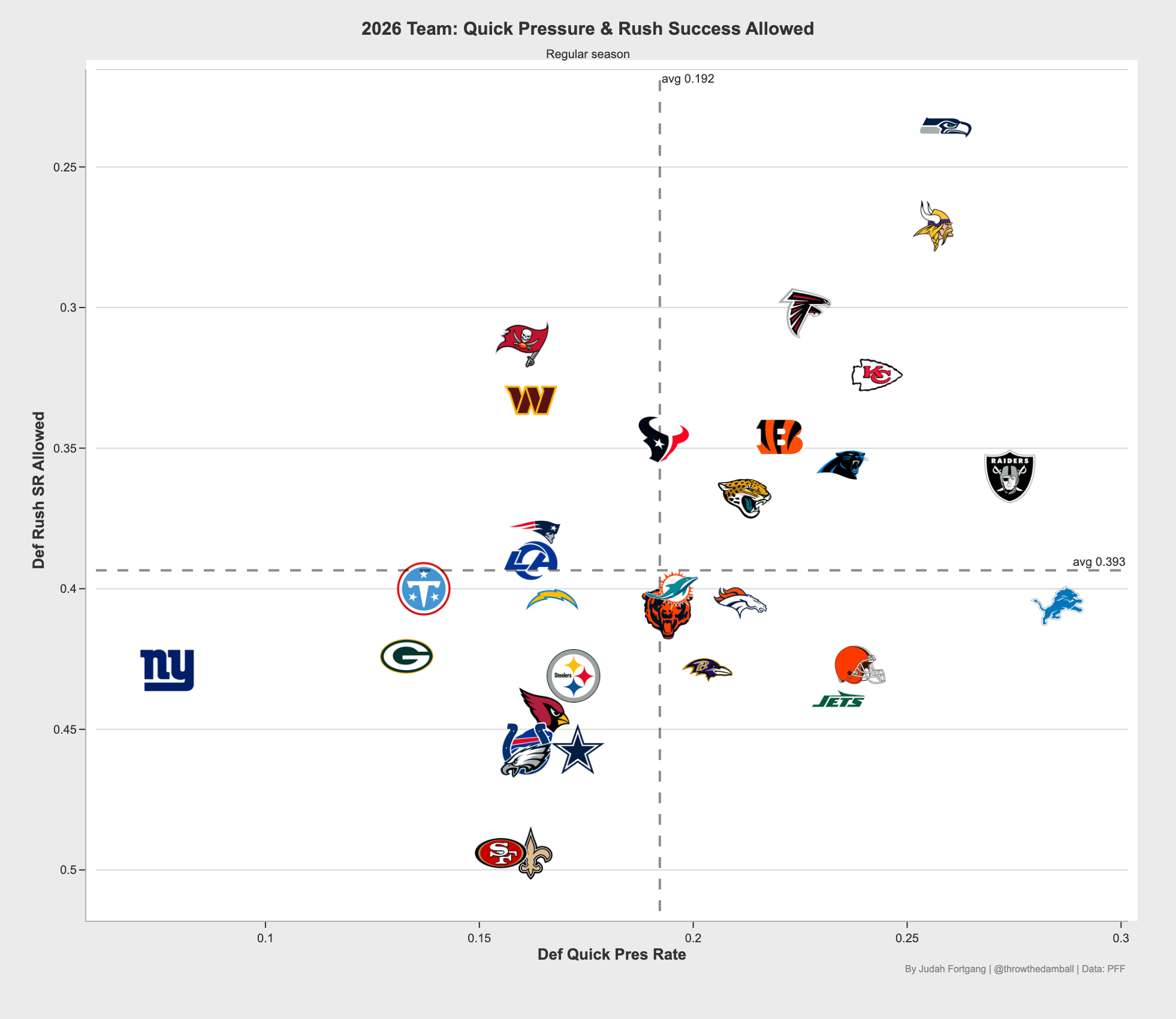
The Raiders have the 2nd best quick pressure rate in the NFL (pressure before 2.5s) and have done a terrific job stopping the run. On the micro level quick pressure creates forced decision making and more turnovers. Stopping the run, meanwhile, often creates a favorable game state with long distance and obvious passing situations where a similar forcing effect occurs. (the Raiders have a top 10 rate of obvious passing situations forced).
And even without the turnovers, the team has done a decent job on the play level-- stopping the run as you see above with the Success Rate and with the 8th lowest Yards Per DropBack in the passing game. What has most notably changed?
Again, new defensive coordinator, Rob Leonard, has been a wizard scheming up pressure on blitzes.
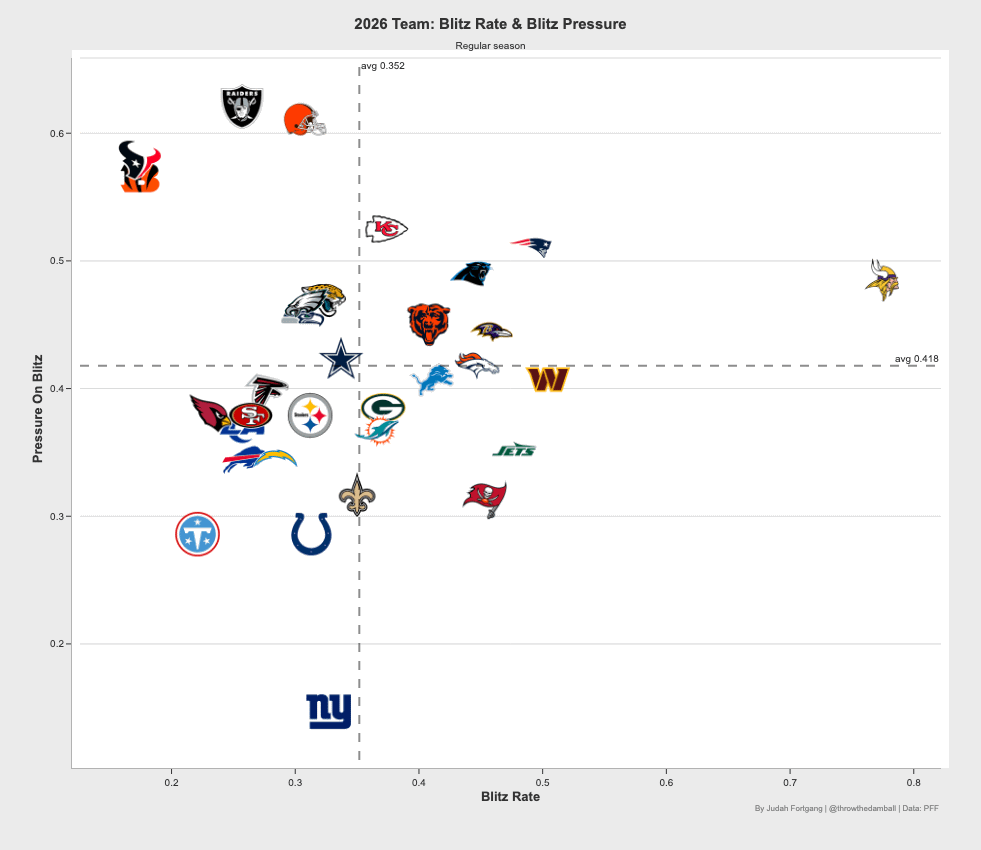
The Raiders might have one of the lower blitz rates in the NFL, but they’ve been the best at generating pressure on those blitzes (and hence the great quick pressure mark).
New coaching blood has injected some signs of life on both sides of the ball for the Raiders, and how opponents begin to adjust is an open question in the coming weeks. Are they a surprise team with good coaching and stable QB play with more than a 40% chance at the playoffs? Or is this a team riding the turnover variance and Cousins overperformance in system to a 3-0 start with the playoff odds pricing in too much of past play and not enough of future play?
This is not a super bowl contender, but I’m cautiously optimistic that this is a serious football team and one that might be severely underrated in the market— what do you think?
That’s it for now, will be back Friday for Part 1 of the Betting Gameplan. As always, appreciate the support and spread the good word about throwthedamball!