


It’s Wednesday night and I miss football, so the best thing we can do is write about it instead.
Intro Thoughts
If I could boil down the fundamental problem with football prediction and forecasting it would live in how football operates in small samples where signals are incredibly hard to parse through. Models are trained by having large amounts of data, and football offers complexity in both in its interactions of 22 people in a complicated game, and in the limited samples of plays (17 games and slightly more than 100 plays per game) with which to work and train on.
Why do we go through this preamble? Well, in my view, there are often important contexts and confounding factors which can better allow us to understand which data points have signal and which are capturing noise. We’re going to be wrong plenty in parsing this through but hopefully we are more often right and wrong— and at the very least there is more data and context for any individual to combine with their own priors and understanding to form a view.
Q: Is it time to give up on Justin Herbert?
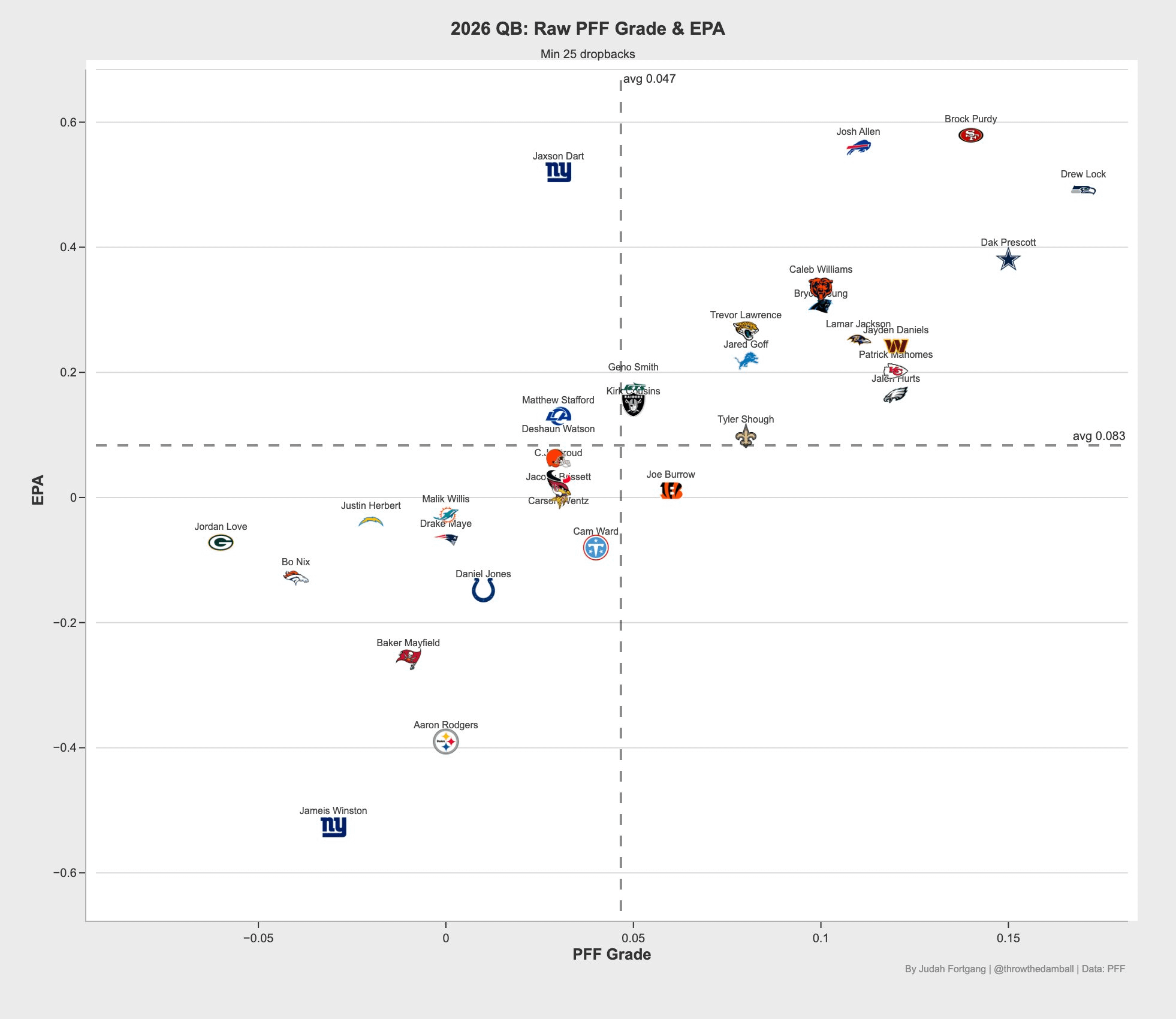
Through 2 weeks it has been a major struggle for Justin Herbert, with the 4th lowest PFF Grade and EPA/Play not far behind as the team lost to two of the worst projected teams in the Cardinals and Raiders.
The Chargers have begun the season by running the ball at one of the highest clips in the NFL.
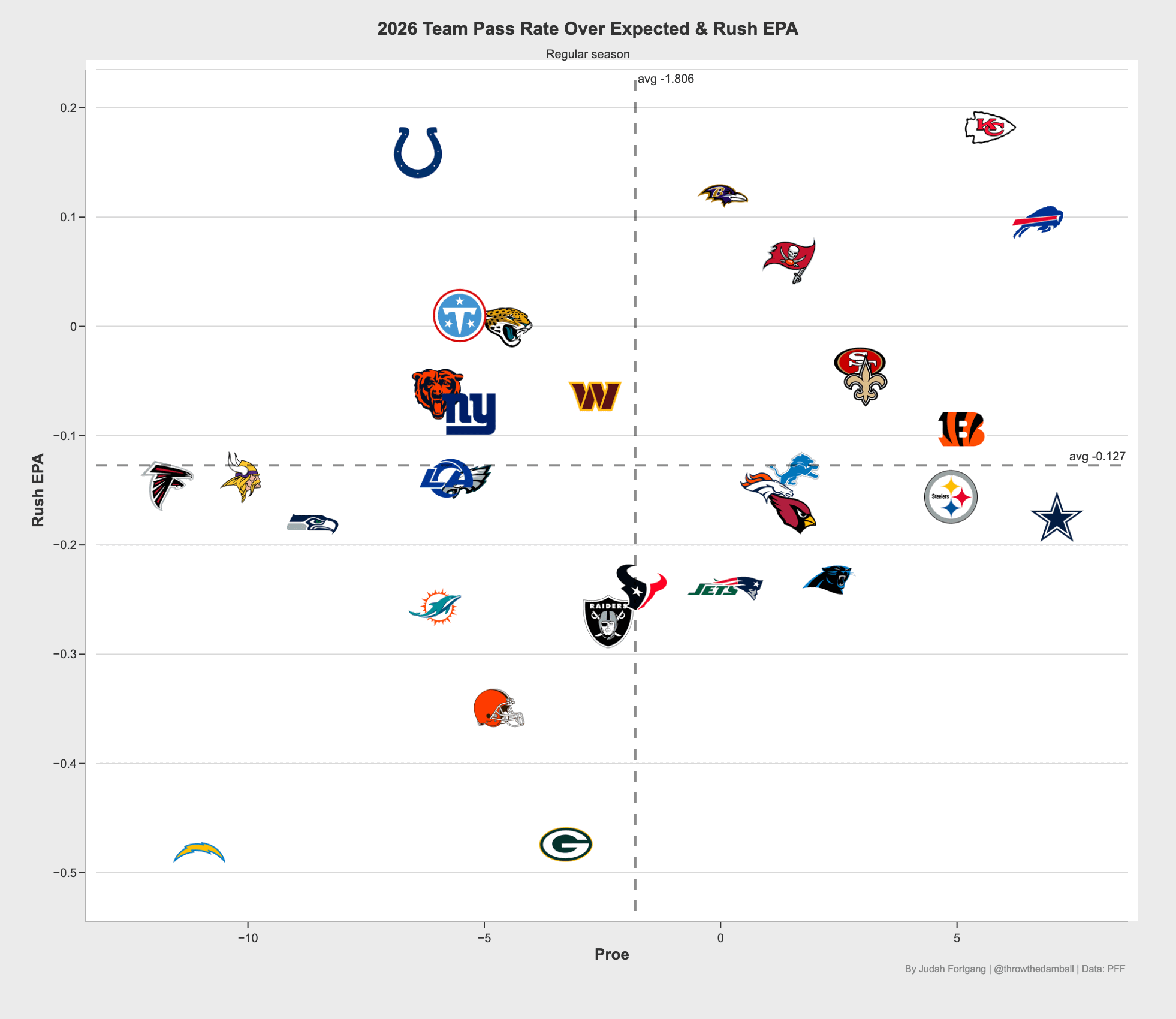
Adjusted for the situation, only the Falcons have run the ball more often than the Chargers. And in terms of their ability to earn points on those runs, no team in the NFL has been worse than the Chargers. The result has been an offense often in obvious passing situations (where the team is 75%+ likely to pass) and playing behind the sticks.
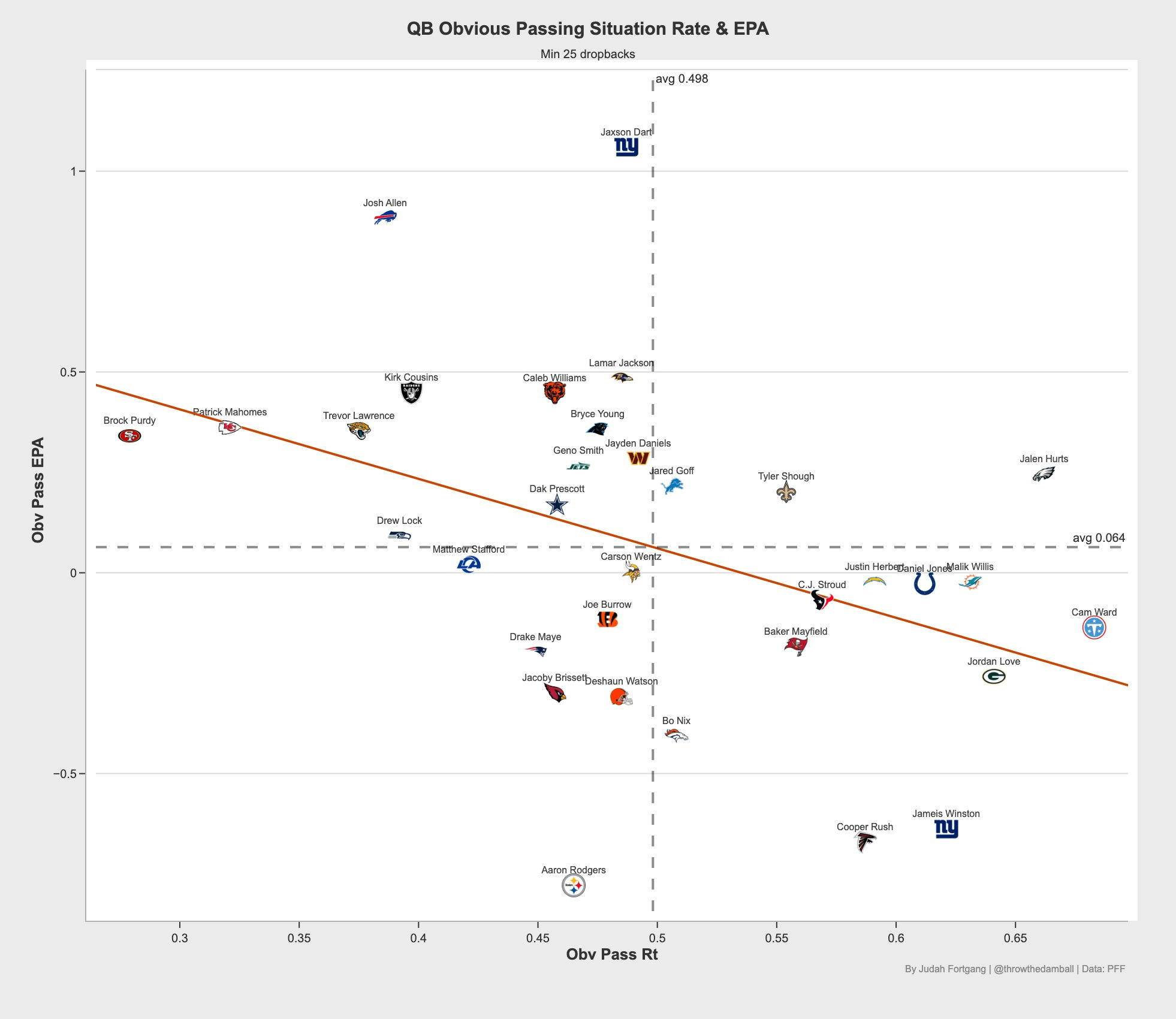
Only a handful of QBs have found themselves in more obvious passing downs— and to Herbert’s credit, this has not been the main area of production where he has struggled. Of course, the base rate of success is lower on obvious passing situations and of the 20 games in the last 2 seasons he has played, he saw the 4th and 8th highest rate of obvious passing situations in the first 2 weeks of the season.
One might expect the poor running game and resulting difficult situations to show up in some of the surrounding contextual offensive stats (pass blocking and getting open are both harder when the other team knows you’re not running), but that hasn’t been the case early this season. In terms of coverage mistakes forced (forcing a blown assignment) , disruption pressures (plays where a QB can’t go through his read), perfect blocking (where nobody in protection blows their assignment) the numbers actually look better in terms of his surroundings.
The Perfect Block rate, was 5th and 6th best for games over the last two years. Coverage mistakes forced? 6th best and 7th best. Disruption pressures allowed? Average games for the last two seasons (8 and 12). In proxies we can capture his surrounding units, it has been better despite more obvious passing situations stemming from a poor run game.
Now perhaps there is a noticeable change in play style with his time to throw, or ability to extend? Taking more sacks? Not at all. His play extension is exactly the same as last year’s average, sack rate and pressure to sack rate the same. His rate of scrambling? Exactly the same. Time To Throw? Nearly identical and all in the middle of the distribution for games in 2025 and 2026 (the more statistically sound point of comparison). Has his accuracy declined? No notable differences in accuracy.
So what has been the main difference? Herbert has had some of the worst deep games of any QB in the last few years. Of QBs with 10 dropbacks in games since 2020 Herbert’s deep EPA ranks 1 1,943 / 2,847 and 2,814 / 2,847. And deep plays, both because they are rare and because they are also heavily influenced by the way a WR tracks/plays at catchpoint (peep our earlier point on sample + interaction) are often less stable than the way a QB, can for instance, evade the rush and scramble which is much more stable.
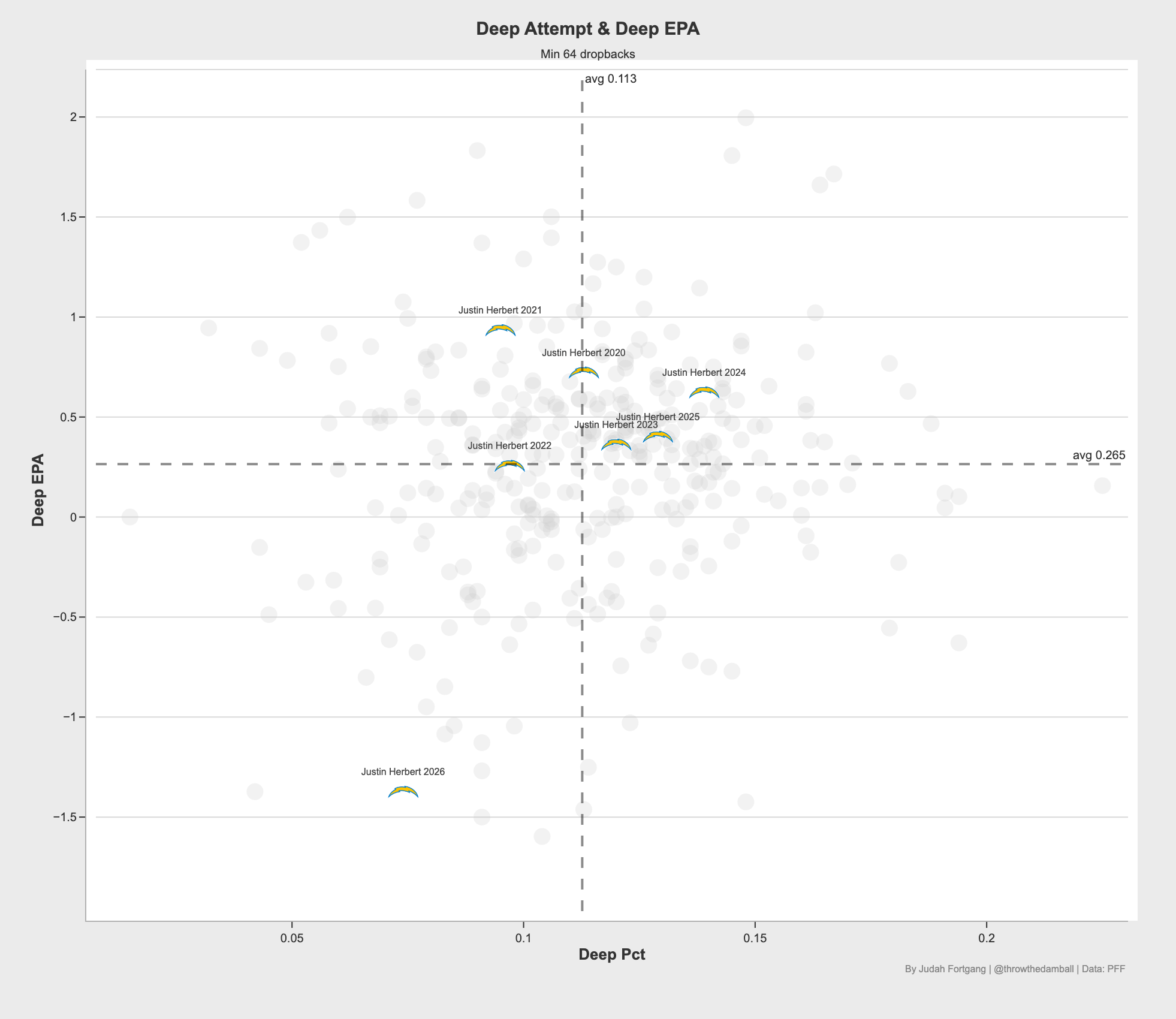
Of course, this a QB in Herbert who has not had a single year below average in production while throwing deep, and that is almost certainly going to regress to the mean here with Herbert around the same spot as he has been every other year in a larger sample.
The other area that pops out year to year is how Herbert has played against the blitz. Herbert has had major trouble picking up blitzes early in the season, with his blitz grades in the 6th and 9th percentiles early in the season. Herbert saw pressure on 7/10 blitzes last week and has been sacked on 25% of snaps against the blitz through the first 2 weeks .
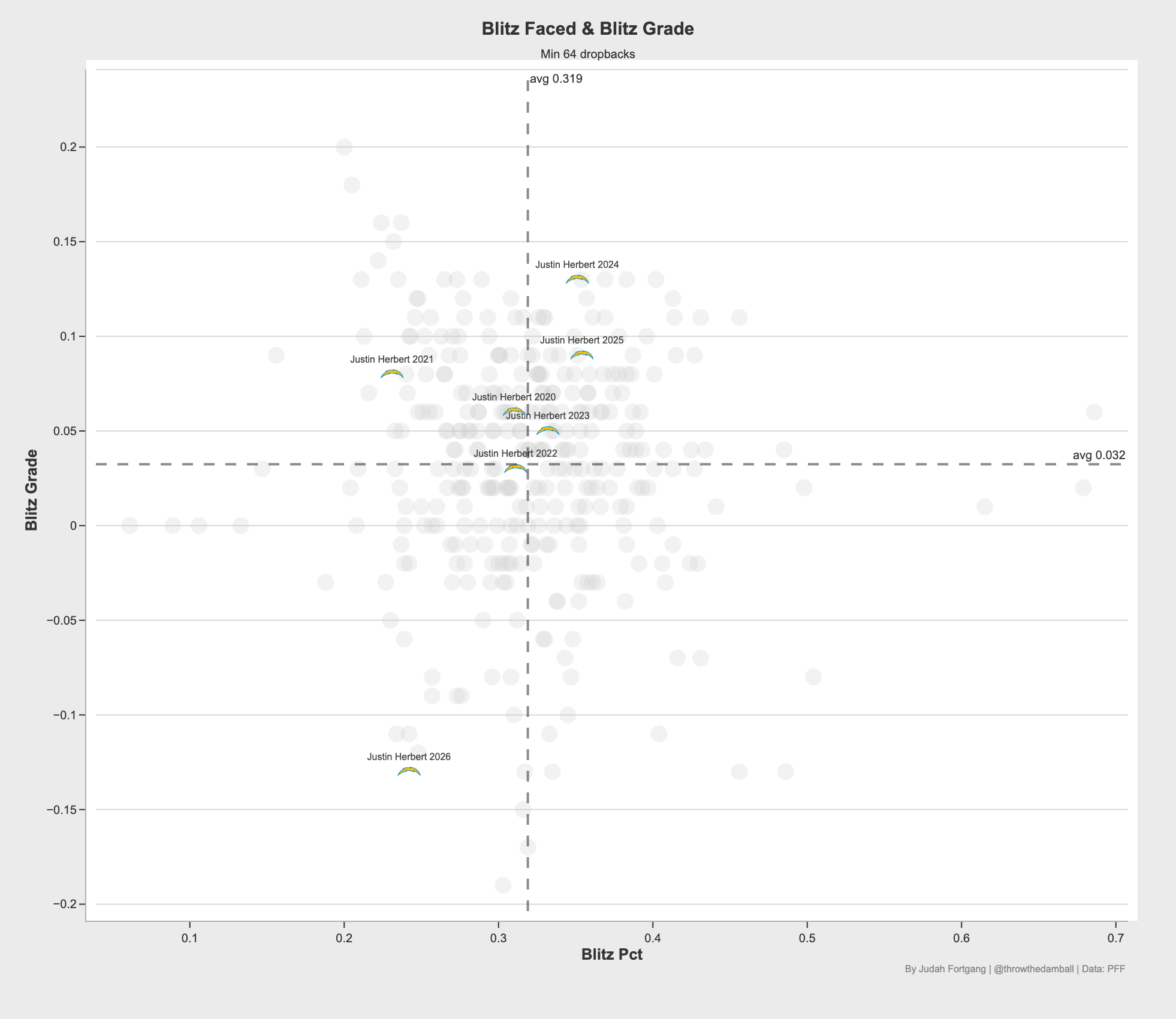
Again, if we take a look at where this would rank for the full season, it is massively lower than his career averages in the category which isn’t to compare his 2 week performance to an 18 week sample, but instead to suggest where production is likely to move over a larger sample.
Now we can return to our original questions—what can we make of this data? What part has more signal looking ahead? I don’t think Herbert has gotten magically worse in these areas, especially deep which is prone to lots of variance on a single play level (a deep drop turned into an INT for instance for Herbert). Herbert is entering a new offense and the cadence and protections are seemingly off especially in picking up the blitz. Can that continue? Perhaps. And while it might point to a flaw in Herbert’s ability to ascend into the elite tier of QBs many projected onto him— that he can’t overcome these changes and he perhaps struggles diagnosing defenses and “seeing the field”—I would think it is more likely as the offense gets more reps and gets in rhythm these problems will stabilize and Herbert will return closer to his career averages.
What I do think carries more signs looking forward is that the protection is better sticking to their assignments, there are more open windows and WRs throughout the offense. And most of all, there is little to suggest a change in Herbert’s play style that would suggest he’s about to enter a declining period.
The market has sold on LAC (6-7% win probability vs a neutral opponent) and on the offense in particular. I think it is safe to say McDaniel is not the magic bullet to turn Herbert into an MVP QB in year 1. But this still has the makings of a solid QB and an offense with still potential to be one of the better offenses in the NFL.
Perhaps we will be wrong, and time will tell (beauty of betting markets is that it is the best arbiter of these opinions) but I think this be a good reminder of the randomness and variance that can happen in a small sample of NFL games. I won’t be surprised to see the Chargers putting up some big offensive numbers in the weeks ahead for, dare I say it, a better pass offensive environment than Herbert has had in years.
Will be back shortly with the Betting Gameplan. As always, appreciate the support and encourage questions/comments/criticism here— and spread the good word about Throwthedamball!
A Wednesday article is a treat, thanks for posting!